What is a CHW?
A community health worker is a frontline public health worker who is a trusted member of and/or has an unusually close understanding of the community served. This trusting relationship enables the worker to serve as a liaison/link/intermediary between health/social services and the community to facilitate access to services and improve the quality and cultural competence of service delivery.
A community health worker also builds individual and community capacity by increasing health knowledge and self-sufficiency through a range of activities such as outreach, community education, informal counseling, social support and advocacy.
This definition was first developed by the CHW Section and codified through APHA policy in 2009.
What do CHWs do?
CHWs play a variety of roles and functions in the many settings where they work. The foundational role of CHWs in Minnesota is culturally appropriate health education and assisting individuals in applying provider recommendations to their lives. Health education topics covered by CHWs are as wide ranging as the health needs of individuals; some CHW programs focus on specific education topics like vaccines, car seat safety, diabetes prevention and cardiovascular health. Another main role is bridging the gap between health systems and communities, including assisting with insurance and medical paperwork, improving access to medical care, and connection to health resources. Another impactful function is navigating community support options to address social determinants of health, including access to food support, transportation, and housing resources. CHWs assist patients with detailed health care system navigation, which starts with empathetic listening and is often rooted in shared life experience and/or cultural congruence with the patient. When CHWs are integrated and trusted members of healthcare teams, they provide vital insights for other healthcare professionals and health systems to better serve individuals and communities. Finally, CHWs advocate for systems change to both the CHW employer organization and across community resource systems (medical, social service, public health).
To learn more about the wide variety of job titles, settings, roles, and functions of CHWs in Minnesota see
What is the state of the CHW workforce now?
In 2024, the Minnesota Department of Health conducted an Environmental Scan of the CHW Field in Minnesota. To read the full report or the summary, click these links:
How are CHWs trained?
Lived experience and cultural congruence are fundamental to CHW’s value for patients and program participants; many CHWs feel that they have been ‘training’ to be CHWs for their entire lives. They are often the ones who help their family members and community find and access resources. We often hear, “I think I’ve been a CHW for years without knowing it!”. Currently, CHWs are not required to be certified in Minnestoa. There is a 16 credit CHW Certificate program which provides CHWs with core competencies and allows CHWs to bill Minnesota Health Care programs (MA and MinnesotaCare) and Medicare under an eligible provider.
In 2022, Minnesota launched a Registered Apprenticeship Program through the Department of Labor and Industry for Community Health Workers. Registered Apprenticeship combines the CHW Certificate program with on-the-job training and mentorship.
How are CHWs funded?
CHW programs are funded in a variety of ways in Minnesota including foundational grants, government grants and contracts, general operating dollars from employing organizational and billing for CHW services. Many organizations use a combination of funding sources by ‘braiding’ organizational funding, grants and billing to maximize sustainability. In order to bill Minnesota Health Care Programs and Medicare for services, CHWs must complete the 16 credit CHW Certificate Program, enroll with DHS and bill under an eligible provider (physician, advance practice nurse, dentist etc.).
Where do CHWs work?
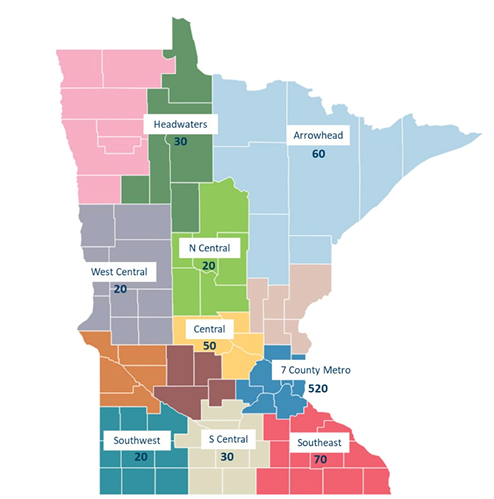
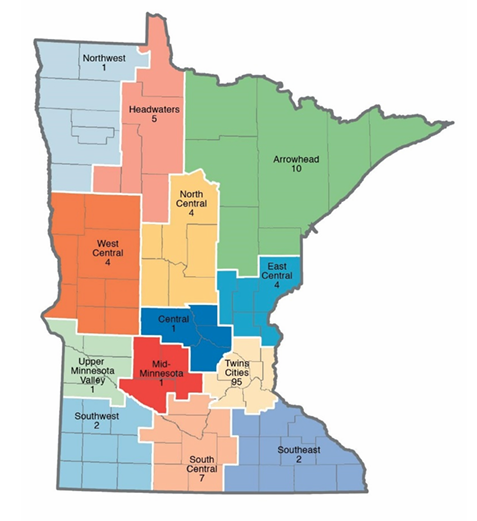
CHWs work in many settings throughout the entire state of Minnesota. The 2024 Environmental Scan (linked above) found CHWs working in 11 settings including, “community organizations, local health departments, managed care plans, mental-health centers, long term care facilities, and health systems”. The scan also found that CHWs are working in over half of Minnesota counties (47). Below are some maps that were included in the 2024 Environmental Scan.